


Introduction
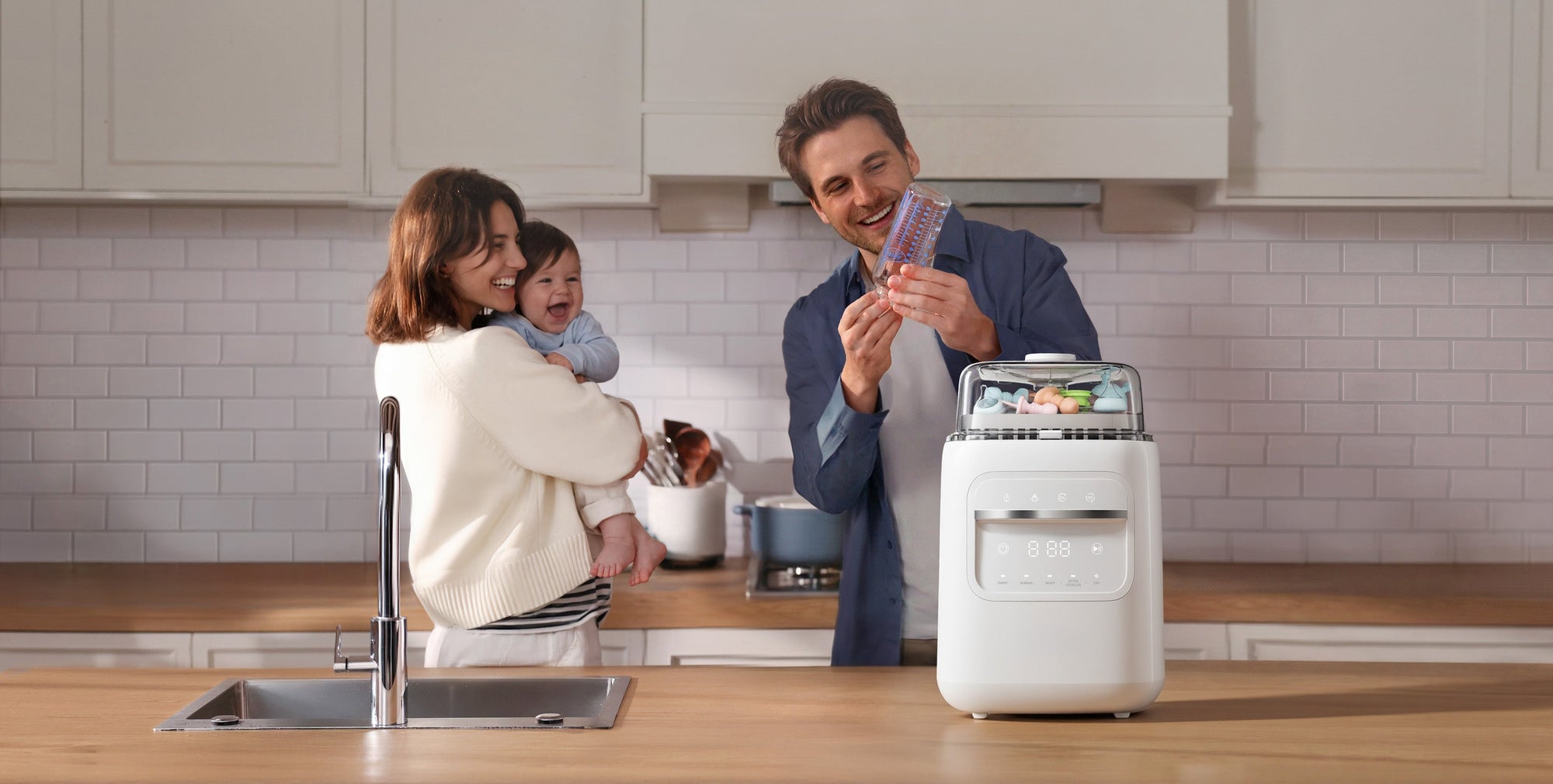
At midnight, it is never just one bottle. It is bottles, nipples, pump valves, flanges, and caps scattered across the counter while you try to remember what is clean, what is drying, and what you already forgot in the sink. That chaos is not only exhausting. It is also where routines break: parts stay damp, residue lingers in tiny crevices, and you end up doing a rushed re-wash right when your baby needs the next feed.
This guide helps you pick the right Baby Bottle Washer, Baby Bottle Sterilizer, Bottle Warmers, and storage devices by matching them to your real workflow and your baby's risk level, especially for NICU parents and new parents. You will learn the foundations (cleaning vs sanitizing vs sterilizing, cycle and capacity math, parts taxonomy), then walk through practical modules you can copy at home: an all-in-one wash-sanitize-dry station, a Steam Sterilizer setup, travel warming hygiene, a Breast Milk Cooler chain, and a Smart Baby Bottle Station workflow.
Official Site: Papablic
Core Foundations
Cleaning vs sanitizing vs sterilizing
If your routine is failing, it usually fails in the definition step. Cleaning means removing milk film, fat, and visible residue using detergent, friction, and water. Sanitizing means reducing germs to safer levels after cleaning. Sterilizing is a higher bar, but many home devices marketed as sterilizers are more accurately sanitizers in the strict regulatory sense.
For day-to-day parenting, the practical rule is simple: you cannot skip cleaning and jump straight to a Baby Bottle Sanitizer cycle. Germ reduction works best after residue is gone, because residue shields microbes and creates odor problems later. The CDC explicitly frames this order for pump parts: clean first, then sanitize, then allow to air-dry thoroughly (not towel-dry). According to the Centers for Disease Control and Prevention, sanitizing is especially important for babies under 2 months, premature babies, or babies with weakened immune systems.
Workflow math: cycles, loads, and where downtime hides
Before you buy any All-in-One Feeding Solutions device, do the math on your worst 6-hour window. Most families do not struggle across a whole day. They struggle during the highest-demand stretch: cluster feeding, back-to-work pumping, or a growth spurt.
Use this quick mental model:
- Parts generated per feed: bottles + nipples + rings + caps
- Parts generated per pump: flanges + valves + membranes + connectors + collection bottles
- Buffer sets: how many complete sets do you own
- Turnaround time: wash time + sanitize time + dry time + cool-down
If your turnaround time is longer than the time until the next feed or pump, you either need more sets, faster cycles, or a different device. This is why a Fast Drying Baby Bottle Sterilizer or a Hygienic Bottle Dryer often fixes the problem more than a stronger wash cycle does. Dryness is not just comfort. Dryness is what allows safe storage without that stale smell.
Parts taxonomy: bottles, pump kits, and the tiny pieces that cause big stress
When you read capacity claims, ignore the marketing photo and picture your actual parts. Bottle capacity is easy. Pump capacity is where devices win or fail.
A Baby Bottle Cleaner or Automatic Bottle Cleaner needs strong coverage for narrow channels. This is why 360-degree spray coverage, dedicated small-part baskets, and predictable placement matter more than raw size. If you are pumping often, you are not washing one kit. You are washing the same tricky pieces repeatedly, and small placement mistakes become daily failures.
Risk tiers: NICU, preterm, newborn, and what changes in your routine
Your baby's risk level should change your minimum standard, not your anxiety level. A high-risk baby is not a reason to panic. It is a reason to simplify your process so you can repeat it reliably.
A practical tiering approach:
- Highest risk: NICU parents, premature babies, medically fragile babies
- Higher risk: newborns under 2 months, babies with known immune concerns
- Typical risk: older, healthy babies with consistent growth
For higher-risk tiers, the safest routine is the routine you can follow even when you are sleep-deprived: clean after each use, sanitize at least daily, and keep parts fully dry before storage. The CDC also notes that if you use a dishwasher with hot water and a heated drying cycle or sanitizing setting, a separate sanitizing step is not necessary. That is useful if your dishwasher is fast enough for your schedule, but many new parents find dishwasher cycle times do not match pumping intervals.
Bottle washer + sanitize + dry station

An all-in-one station works when your bottleneck is repeated sink time. The goal is not perfection. The goal is fewer resets: fewer scrubs, fewer emergency rinses, and fewer moments where you realize the last clean flange is still wet. A true All-in-One Bottle Washer setup should cover bottles, nipples, and pump parts in one predictable load pattern.
Build the station around three steps you do the same way every time:
- Pre-rinse: quick rinse to remove milk residue
- Load by zone: bottles upright, small parts secured, silicone separated
- Hands-off finish: sanitize plus hot-air dry so storage is safe
When you are pumping frequently, the payoff is not just time saved. It is fewer touches. Less handling reduces mix-ups, and it reduces the chance you set a clean valve on a questionable counter.
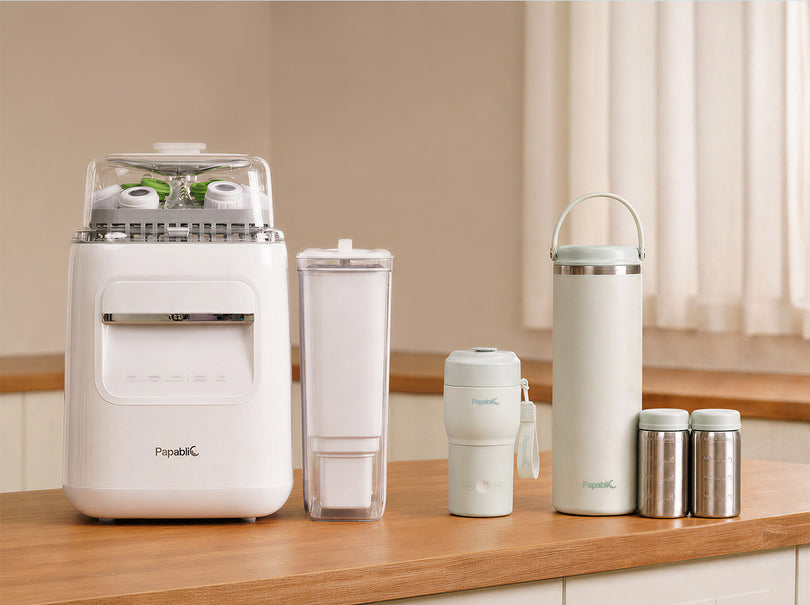
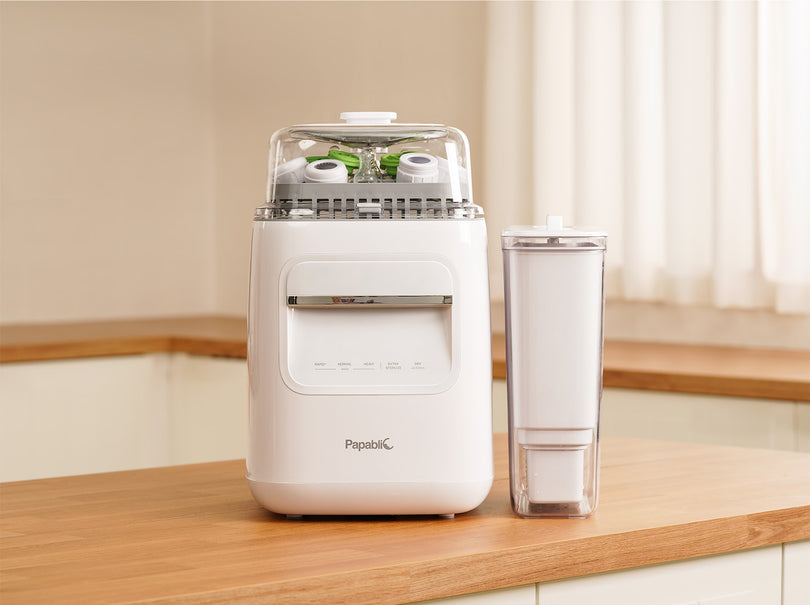
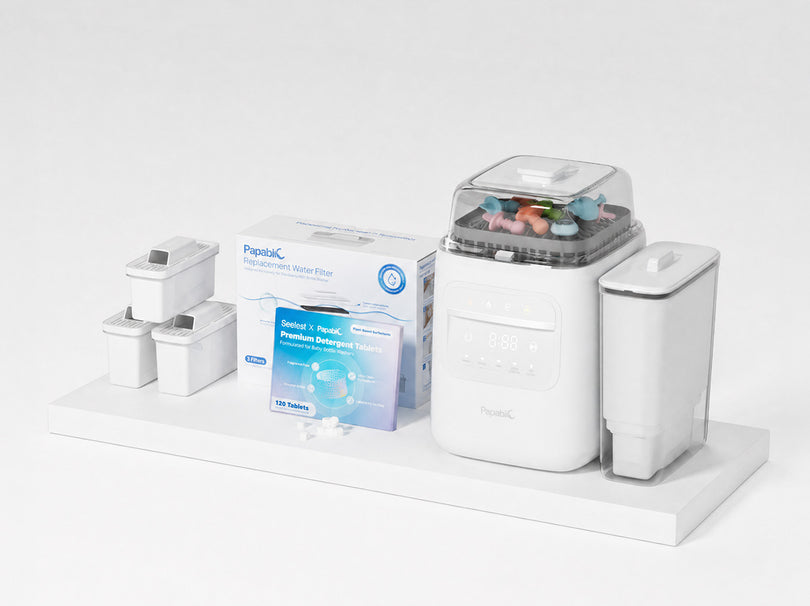
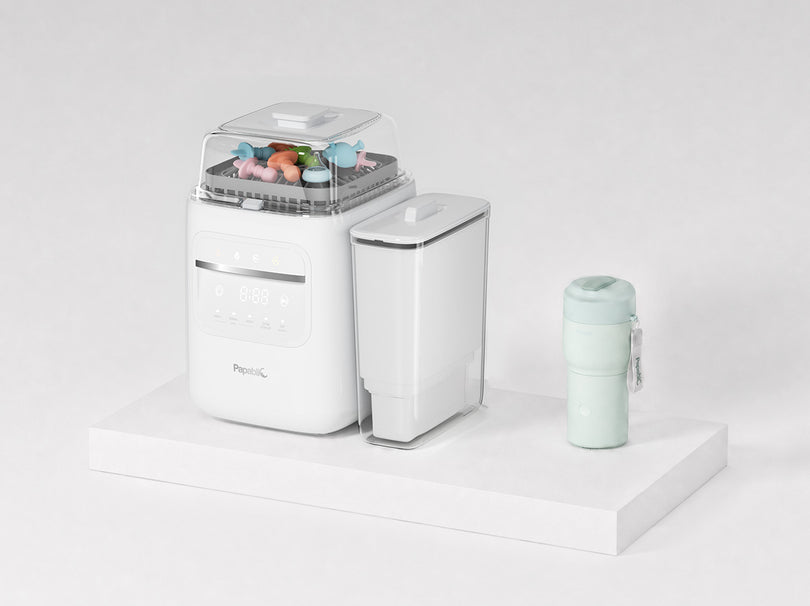
For a device example, the Papablic SafeguardPlus Baby Bottle Washer System positions itself as a 5-in-1 Baby Bottle Cleaning System with built-in PurifyClean Water Purification, upgraded capacity for 8 bottles and wearable pumps, and 72-hour hygienic storage. It also states that its water purification removes lead, PFAS, and hard minerals, and that the filter replacement reminder triggers every 30 wash cycles. If you live in an area with hard water or you are tired of limescale management, water handling becomes part of the decision, not an afterthought.
Shop: Papablic SafeguardPlus™ Baby Bottle Washer System
Steam sterilizer and dryer setup
A Steam Sterilizer and dryer setup works when your wash step is already handled, but your germ-reduction and drying steps are inconsistent. Many families can wash parts. The breakdown happens later: parts are left to air-dry in a crowded space, someone towel-dries to speed things up, or clean parts sit exposed on the counter.
To make steam plus drying work, design for fast turnaround:
- Wash first: handwash or dishwasher, but remove milk film completely
- Sterilize in batches: align a steam run with your next feed window
- Dry fully: do not store damp parts, even if they look clean
According to the CDC, you should allow parts to air-dry thoroughly after sanitizing and avoid rubbing or patting dry with a dish towel because that can transfer germs back onto the item. This is exactly where a Bottle Sterilizer and Dryer can remove the most friction: consistent, repeatable drying without extra handling.
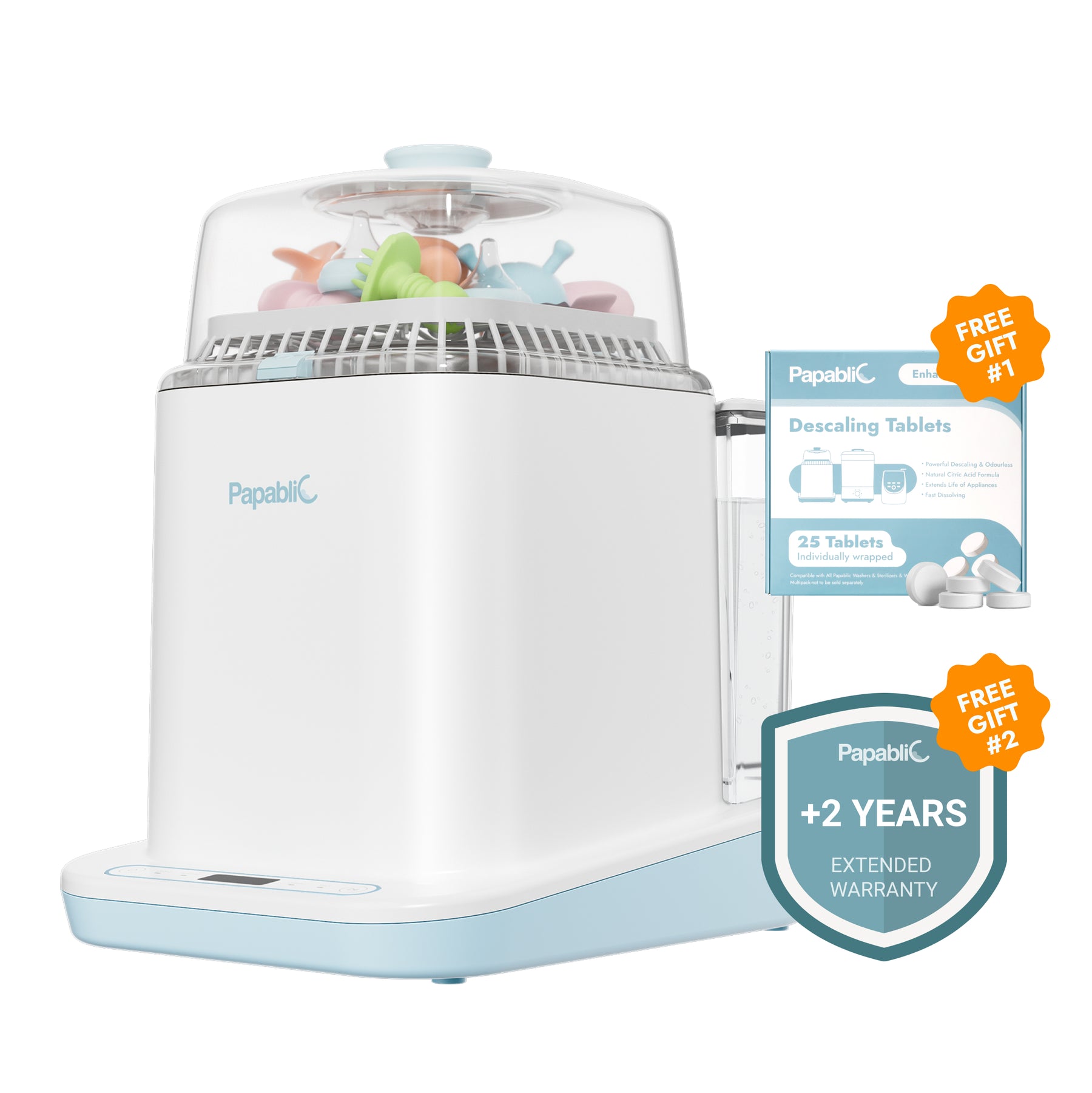
If you want one appliance that combines the steps, Papablic also sells a Baby Bottle Washer Sterilizer and Dryer All-in-One Bottle Cleaner that describes a 4-in-1 auto system (wash, steam-sterilize, dry, store) and highlights 26 precision jets with 25,000Pa pressure. It also claims 99.99% sterilization in 19 minutes and a capacity targeting up to 6 bottles plus 2 full pump kits per cycle. In real life, that capacity number matters only if your actual pump parts fit without blocking spray paths.
Shop: Baby Bottle Washer Sterilizer and Dryer All-in-One Bottle Cleaner with 25 Descaling Tablets
Portable warming and travel hygiene
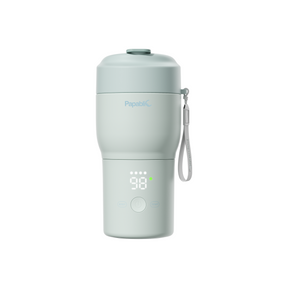
Travel is where routines get replaced by shortcuts. You might warm a bottle in a mug of hot water, use a questionable sink, or reuse a part because you did not pack enough. The right Portable Bottle Warmer or Travel Bottle Warmer reduces the number of compromises you make in public, in cars, and in hotel rooms.
When evaluating Portable Bottle Warmers, focus on three criteria:
- Temperature control: steady warming instead of overheating
- Real portability: size, leak resistance, and easy cleaning
- Hygiene handling: how you keep threads, seals, and lids clean
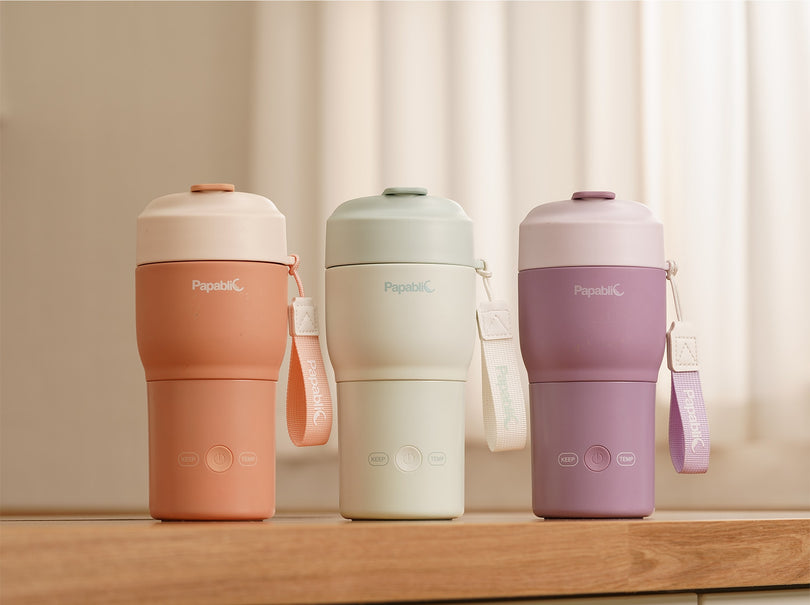
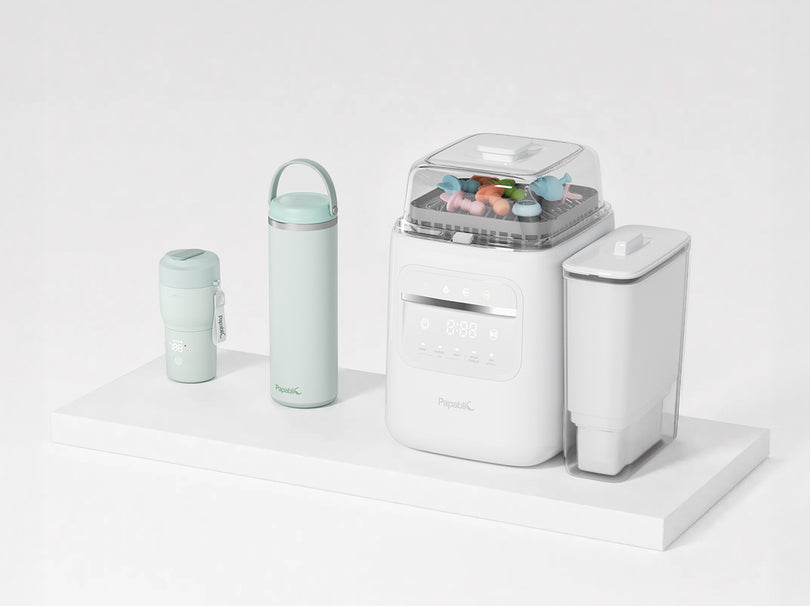
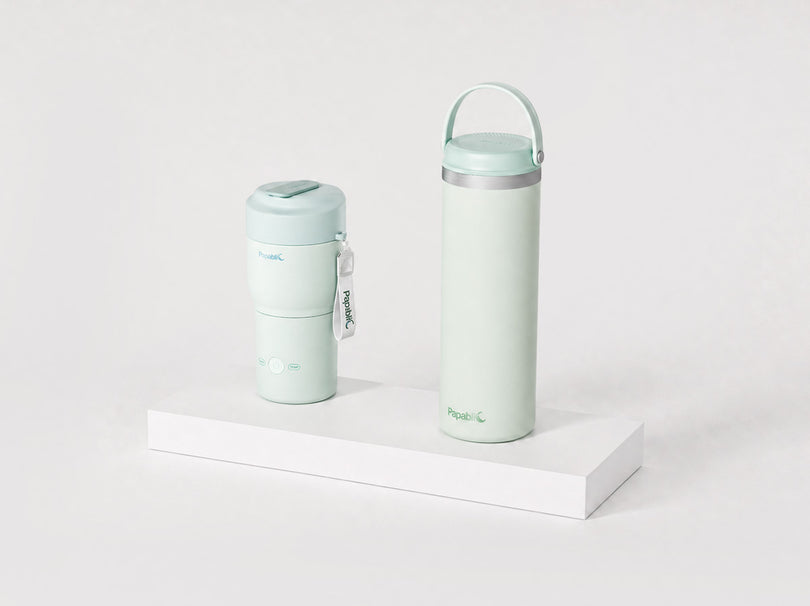
If you frequently feed away from home, a Portable Baby Bottle Warmer with built-in sterilization can simplify your kit. Papablic markets the Portable Bottle Warmer and Sterilizer line as warming plus built-in sterilization, and it claims fast warming (for example, one model states 3 minutes 45 seconds). The practical benefit is not the headline time. It is the reduced need to find a clean sink or to trust random hot water sources.
Travel hygiene still needs a method:
- Pack a clean, sealable bag for clean parts
- Pack a second bag for used parts
- Plan one daily reset when you return (wash-sanitize-dry)
Shop: Papablic Portable Bottle Warmer & Sterilizer
Breast milk cooling and storage chain
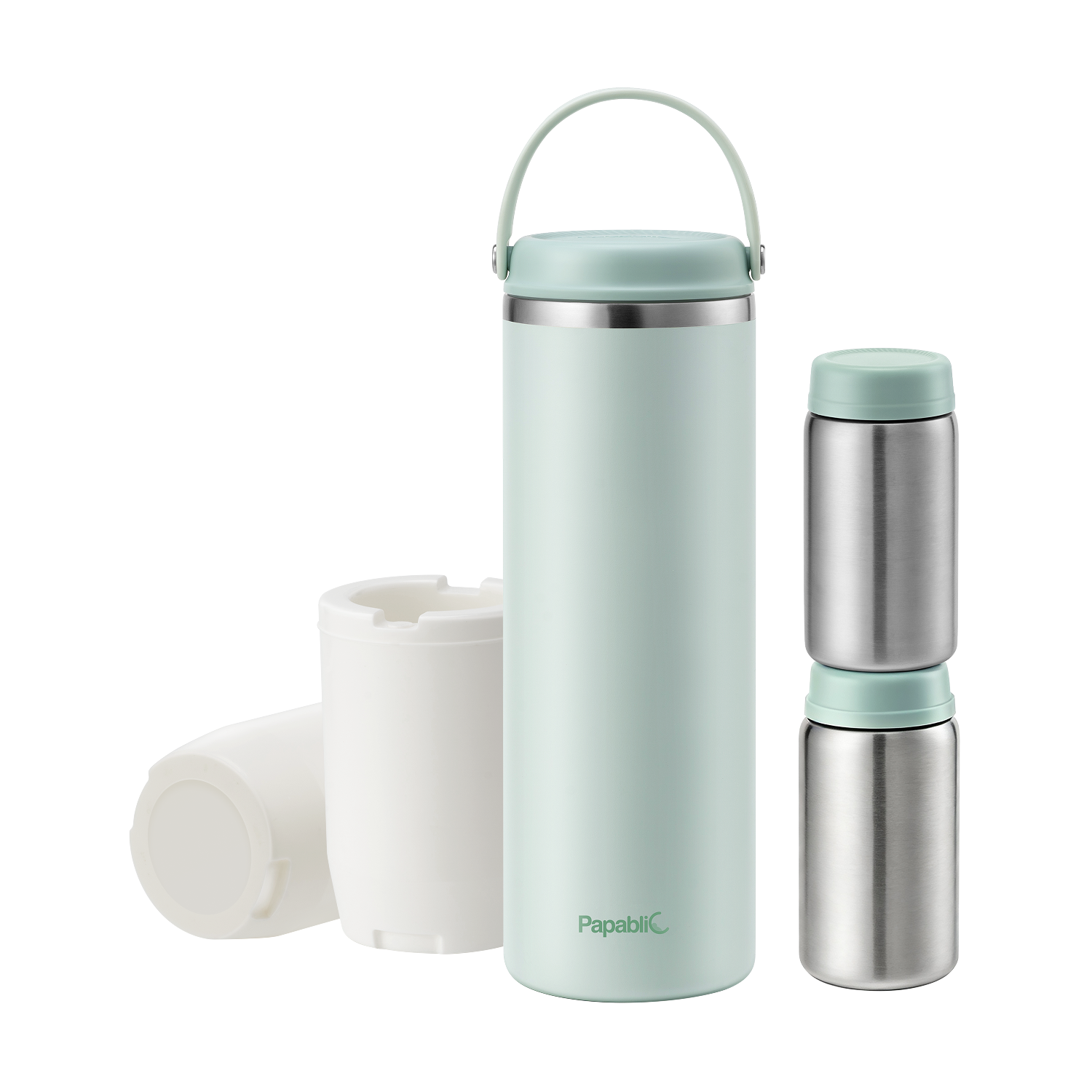
A Breast Milk Cooler is not just a convenience item. It is a link in a cold chain, and cold chain thinking prevents waste. The moment milk leaves the pump, your job is to keep it in a safe temperature range until it reaches the fridge or freezer, with as few temperature swings as possible.
Design the chain in stages:
- Pump stage: label immediately (date and time)
- Transport stage: insulated storage with stable cooling
- Home stage: move to the fridge quickly, rotate the oldest forward
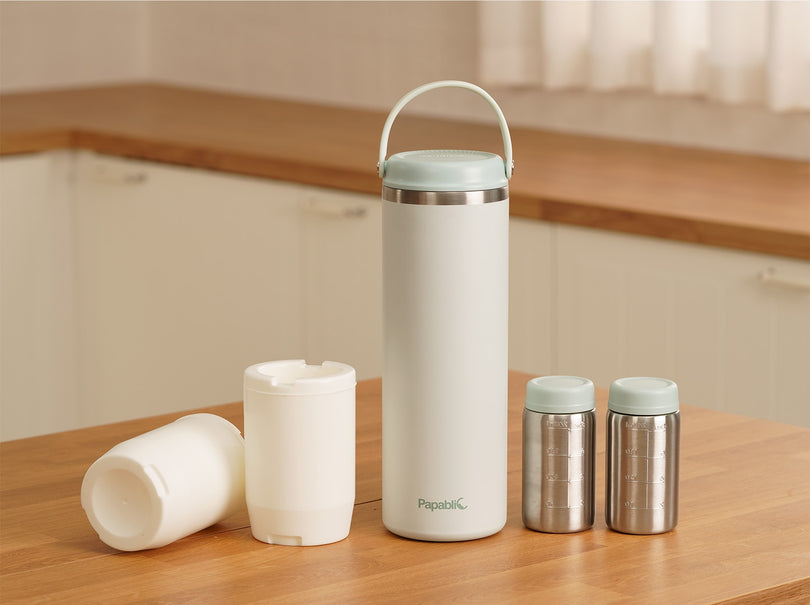
Papablic‘s CapsuleChill Breast Milk Cooler emphasizes portable, TSA-compliant use and safe materials (FDA approved, lead-free, BPA-free). It also uses stainless steel independent bottles and describes each stainless steel bottle as 10 oz total capacity filled to the top, with an 8-ozz marking inside. Compatibility matters if you already use specific collection bottles, so check whether your bottles fit or whether you will decant.
For NICU parents or high-volume pumpers, the biggest advantage of a structured cooler system is fewer decision points. You do not want to debate where the milk goes while you are still half-asleep. You want one path: pump, cap, label, chill, and transfer.
Shop: Papablic CapsuleChill™ Breast Milk Cooler
Smart baby bottle station workflow

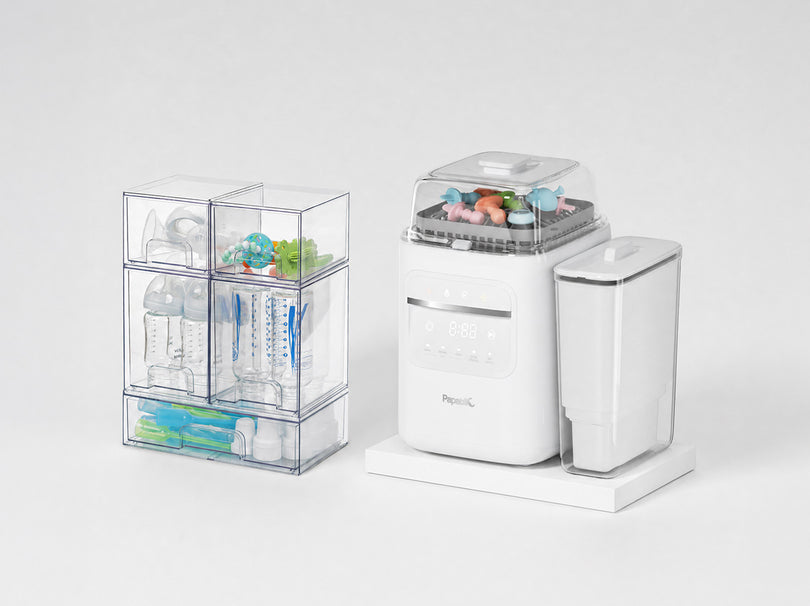
A Smart Baby Bottle Station is less about buying a gadget and more about designing your environment to prevent mistakes. Most overnight errors are not caused by ignorance. They are caused by ambiguous zones: clean parts next to used parts, bottles staged without labels, or parts that look dry but are not.
Build your station like a mini process line:
- Dirty drop zone: a tub or bin that is only for used parts
- Wash zone: the device or sink basin, with a dedicated brush
- Dry and store zone: closed or protected space for fully dry parts
- Label and rotate zone: prepped bottles front, newest behind
If you are using a Baby Bottle Washer device, treat it as the center of the station. Your goal is to avoid one-off improvisation. For example, if a wearable pump kit is hard to position, create a repeatable loading map: same basket, same orientation, same check for blocked spray paths.
This is also where you decide which Feeding Essentials belong nearby and which do not. You do not want Changing Pads, Baby Bassinets, or Baby Play items cluttering the feeding station. Keep the station single-purpose: bottles, pump parts, detergent, labels, and storage.
Official Site: Papablic
Selection/Decision Guide
Start with the baby risk level, then decide on the sanitization frequency
If your baby is in a higher-risk tier, choose a workflow that makes daily sanitizing easy to repeat. The CDC notes that sanitizing is especially important for babies under 2 months, premature babies, or babies with weakened immune systems. If your dishwasher is reliable and has a sanitizing setting or heated drying cycle, that can reduce the need for a separate step, but only if it fits your timing.
Quick decision cues:
- NICU parents: prioritize sanitize plus dry, minimal handling
- Newborn under 2 months: daily sanitize, strict drying
- Older healthy baby: consistent cleaning, sanitize as needed
Match capacity to your real peak load, not the marketing photo
Capacity only helps if it prevents extra cycles during your peak window. List your typical load:
- Number of bottles per 6 hours
- Pump sessions per 6 hours
- Number of complete pump kits
Then compare that to the device's stated capacity. For example, Papablic describes SafeguardPlus capacity as 8 bottle sets (and mentions pump parts), while its all-in-one washer listing describes up to 6 bottles and 2 full pump kits per cycle. If your household creates more parts than that between cycles, you will still be behind.
Drying performance is a safety feature, not a nice-to-have
A Fast Drying Baby Bottle Sterilizer or Hygienic Bottle Dryer reduces two risks at once: recontamination from towels and odor from trapped moisture. If your parts come out with water droplets, treat that as a system issue. Either change the loading, change the dry time, or change the device.
Water and materials: filtration, scaling, and baby-safe contact
Hard water creates limescale, which can reduce heating efficiency and create residue. Some parents manage it with distilled water or regular descaling. A system with built-in purification and a clear filter replacement cadence can reduce maintenance overhead.
Decision framework table (scenario-based):
| Scenario | Primary bottleneck | Best device type | Key spec to check | Trade-off |
|---|---|---|---|---|
| Exclusive pumping | Turnaround time | All-in-One Bottle Washer | Pump kit capacity | More loading discipline |
| NICU parents | Germ reduction | Bottle Washer with Sterilizer | Dryness consistency | Higher maintenance |
| Travel weekly | Away-from-home feeds | Portable Bottle Warmer | Leak resistance | Smaller volume |
| Office pumping | Cold chain | Breast Milk Cooler | Bottle compatibility | Extra cleaning |
| Small kitchen | Counter space | Bottle Sterilizer and Dryer | Footprint | Smaller loads |
Common Pitfalls to Avoid
- Skipping cleaning before sanitizing: Sanitizing works best after residue is removed. If milk film remains, odors and buildup return quickly.
- Towel-drying and storing damp: Towels can reintroduce germs, and damp storage increases odor and residue problems.
- Overstuffing small parts: Valves and membranes need space and secure placement. If they flip or nest, they do not clean well.
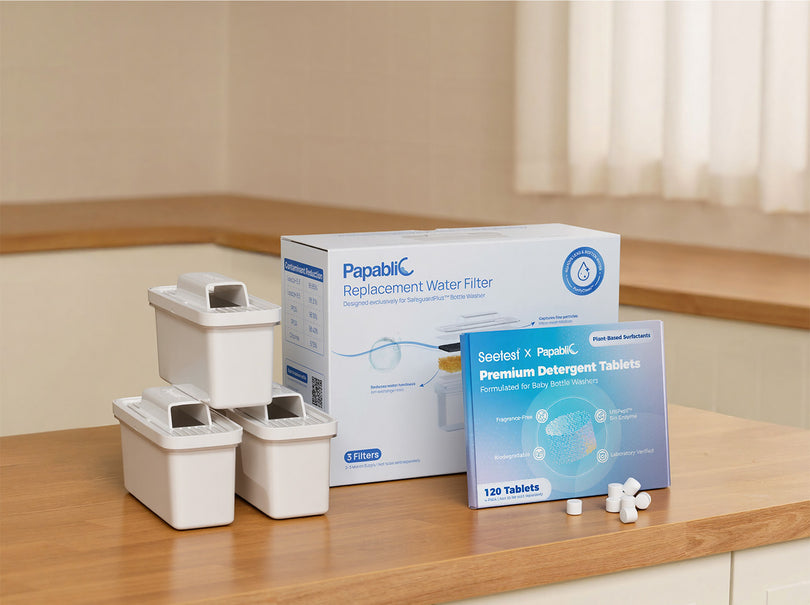
- Ignoring descaling and filters: Hard water maintenance is not optional if you want consistent performance. Build maintenance into your calendar so you do not only react when performance drops.
Conclusion
The best Baby Bottle Washer, Baby Bottle Sterilizer, and Bottle Warmers choice is the one that removes your biggest bottleneck with the fewest daily decisions. Start by mapping your real peak window, your baby's risk level, and the number of parts you generate per cycle. Then choose the device type that makes the safe behavior automatic: clean first, sanitize when needed, and dry fully before storage.
If you want to simplify the entire station, an all-in-one wash-sanitize-dry approach can reduce handling, speed resets, and make routines easier to sustain for new parents and NICU parents.
Official Site: Papablic
FAQ
How do I decide between washing-only and wash-sanitize-dry devices?
Choose washing-only when you have enough spare parts and a reliable drying plan that always produces fully dry items before storage. Choose wash-sanitize-dry when you are frequently behind and you need a consistent turnaround without extra handling. In practice, the decision hinges on downtime: if you will need the same pump kit again within a few hours, integrated drying matters more than maximum capacity. For higher-risk babies, a repeatable sanitize and dry cycle also reduces the odds that a tired shortcut becomes your new normal.
How often should I sanitize bottles and pump parts?
Sanitize frequency should match your baby's risk level and how reliably you can clean after each use. For many families, sanitizing at least once daily is a practical baseline, especially in the early months or when routines are still unstable. If your baby was born prematurely or is medically fragile, your pediatric care team may recommend more frequent sanitizing and stricter handling. Even when you sanitize daily, you still need to clean thoroughly first, because residue can protect germs and cause odors. If you use a hot dishwasher cycle with heated drying and it truly fits your schedule, that may cover the sanitizing step in your workflow.
What matters most for a bottle washer's capacity rating?
Capacity matters only when it matches your real load types: full bottle sets plus the specific pump parts you use daily. A good capacity rating lets you wash everything you need for the next feeding block in one cycle, not two. Check whether the device can hold small parts securely so they do not flip, nest, or block spray paths. Also consider whether wearable pump components fit without forcing awkward stacking, because stacking usually reduces cleaning performance. If you are pumping often, prioritize pump kit capacity over total bottle count.
What is the biggest mistake in the bottle and pump part routines?
Storing parts while damp is the most common failure point because moisture keeps residue active and makes odors come back quickly. Damp storage also encourages you to rewash more often, which increases workload and stress. The fix is usually not a stronger wash. The fix is a more reliable drying step, better spacing during drying, or an automatic dry cycle that finishes the job. If you must air-dry, create a protected dry zone with consistent airflow and enough space so parts do not touch.
How do I build a Smart Baby Bottle Station that actually prevents mistakes at night?
Start by separating zones so you never have to remember what is clean: one dirty drop bin, one wash zone, one dry-and-store zone, and one staging zone for ready bottles. Keep only Feeding Essentials at the station so clutter from other baby Care items does not invade the workflow. Use a simple rotation rule, like newest milk goes to the back and the next feed goes to the front, to prevent accidental out-of-order use. Add one visual check that catches common errors, such as a rule that nothing gets stored unless it is fully dry. If you can follow the station rules half-asleep, it is designed well!