


Introduction
You bought the "universal" washer, but at 3 a.m., you are jamming a wide-neck bottle into a slot made for a standard neck while the pump flange tips over. The lid won't close, the anti-colic vent is stuck, and you realize "fits all" often comes with a frustrating asterisk. It is not just annoying; an overcrowded washer blocks water jets, leaving dangerous milk film behind.
Stop forcing the fit and risking your baby's hygiene. Whether you are mixing tall anti-colic vents with tiny pump membranes, this guide provides the 5-step "fit check" to ensure your machine actually cleans everything you own. Here is how to measure, load, and wash for a truly safe clean.

Official Site: Papablic
How to Choose a Baby Bottle Washer Step by Step
Step 1: Do the Real "Bottle Math"
Before you buy any Baby Bottle Washer, forget the marketing photos and measure what is actually on your counter. This is the fastest way to avoid a Bottle Cleaning System that forces you to hand-wash half your gear.
Measure these four dimensions:
- Height: Measure from the base to the top of the collar ring.
- Diameter: Measure the widest point (crucial for wide-neck brands).
- Accessories: Measure assembled anti-colic vent stacks.
- Pump Gear: Measure flange diameter and the height of assembled collection cups.
Next, map your measurements to the rack design. A removable top tray can make or break the fit for tall bottles. If you are building an All-in-One Feeding Solutions routine, measure for your busiest day, not your lightest.
Step 2: Verify Capacity and Stacking
Capacity isn't just a number on a box; it’s about "usable space." A machine might claim to hold six bottles, but can it fit those bottles and your pump flanges without blocking the spray arms?
Plan for your specific peak demand:
- New Parents: Plan for 6 to 10 feeding events in 24 hours.
- Exclusive Pumpers: Plan around 2 to 4 pump sessions plus bottle rotation.
- NICU Parents: Plan for a daily sanitize cycle plus strict drying.
The Loading Reality Check: Can you load bottles upside down with stable supports? Can you separate membranes so they don't nest? A practical benchmark is whether the washer handles a full day’s load in just one or two runs.
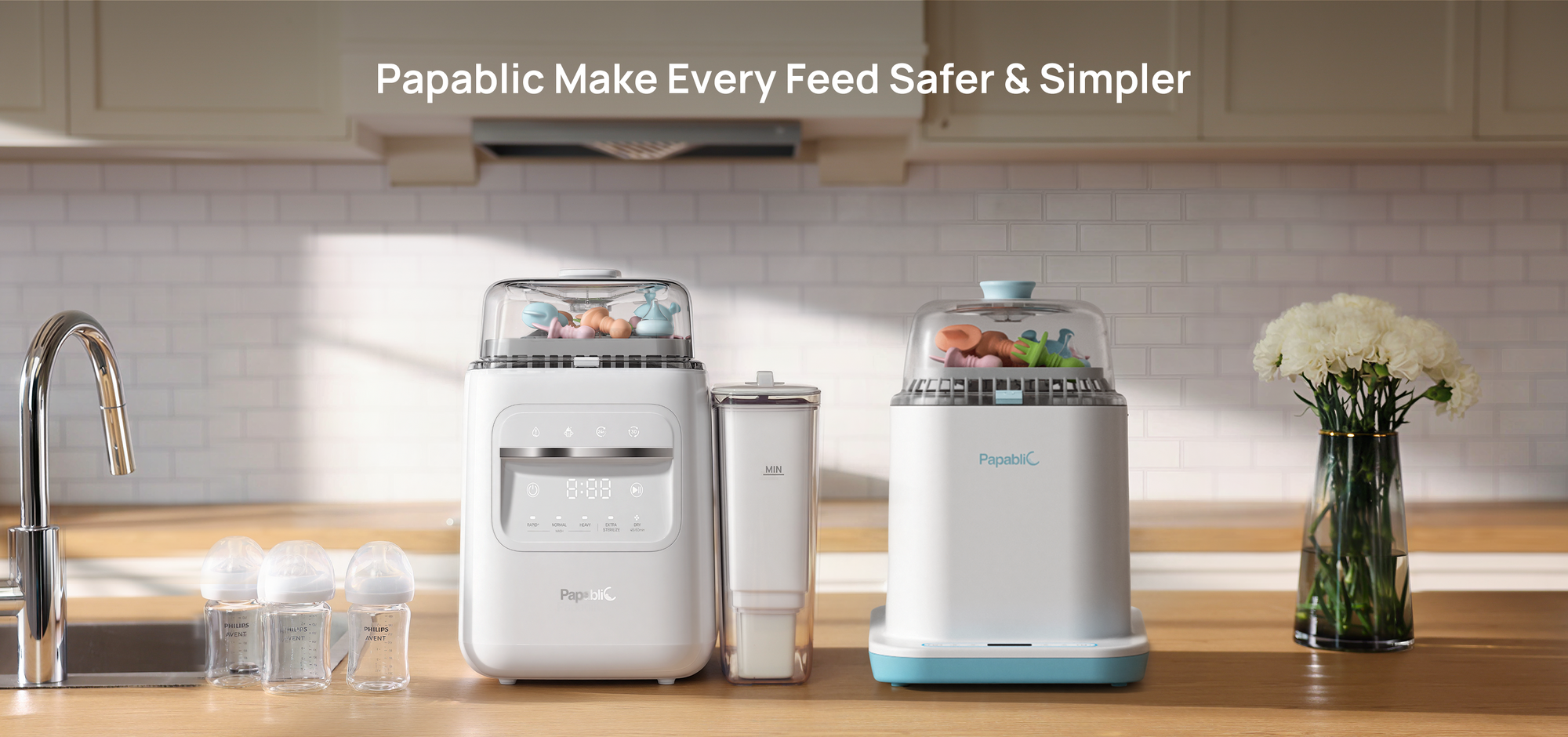
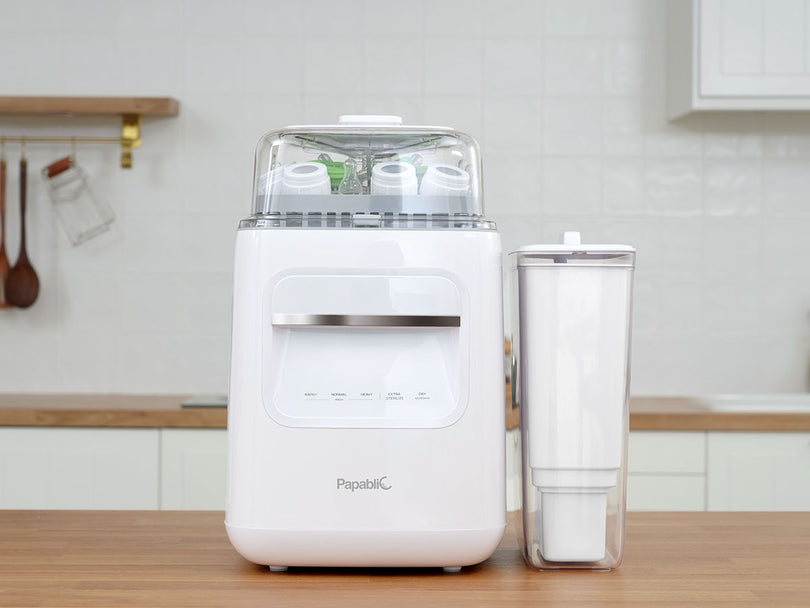
Papablic Capacity: The Papablic Baby Bottle Washer Sterilizer and Dryer uses a double-stack design holding up to 6 bottles and 2 full pump kits per cycle. This density is essential for reducing daily batches.
Step 3: Evaluate Jet Coverage and Pressure
If your Automatic Bottle Cleaner doesn't reach the interior walls, you aren't cleaning—you're just rinsing. Poor jet design leaves a greasy haze or trapped residue under collars, which breeds bacteria.
The Jet Checklist:
- Interior Reach: Jets must shoot into the bottle neck, not just spray the outside.
- Multi-Angle: Water should hit the bottle from the bottom and sides.
- Small Parts Stability: A basket must keep nipples and vents from flipping over.
Performance Note: The Papablic system uses 26 precision jets with 25,000 Pa pressure. This blast is critical for dislodging the fatty milk residue found in breast milk and formula.

Shop: Baby Bottle Washer and Sterilizer Dryer All in One Bottle Cleaner
Step 4: Confirm Sterilize and Dry Performance
Searching for Bottle Warmers often leads to separate sterilizers, but an integrated Bottle Sterilizer and Dryer reduces handling. Every time you move a wet bottle to a drying rack, you risk re-contamination.
Why Steam Matters:
- Steam Sanitizer: Confirms heat-based killing of pathogens without boiling water.
- Hygienic Bottle Dryer: Hot air removes moisture that supports mold growth.
- Speed: A fast cycle helps when you are down to your last clean bottle.
Safety Standards: The CDC recommends daily sanitizing for babies under 2 months, preemies, or those with weakened immune systems (CDC). An automated washer ensures this happens every single time without human error.

Shop: Baby Bottle Washer Sterilizer and Dryer All in One Bottle Cleaner with 25 Descaling Tablets
Step 5: Check Storage Mode and Filtration
A clean cycle is useless if you store the parts wet. The moment a damp bottle hits a towel, it picks up kitchen dust and microbes. A true Smart Baby Bottle Station includes a closed-lid storage mode.
Look for these storage features:
- Closed-Lid Hygiene: Keeps bottles protected for 24+ hours.
- Dry-First Logic: Storage is only safe if items are bone-dry.
- Filtration: HEPA filters reduce airborne dust during the dry cycle.
Washer vs. Dishwasher: While residential dishwashers can sanitize if they meet NSF/ANSI 184 standards (NSF), they often trap food particles in the filter. A baby-specific system provides a dedicated, food-free environment for your infant's gear.
Adapting Your Washer for Different Scenarios
For Wide-Neck Bottles
- Remove the top tray if it blocks the bottle height.
- Space bottles apart so the wide mouths don't touch.
- Ensure the opening aligns perfectly with the lower jets.
For Anti-Colic Bottles with Vents
- Disassemble every vent part; never wash them assembled.
- Place tiny vent tubes in the dedicated parts basket.
- Add a second dry cycle if the narrow vent tunnels retain water.
For Exclusive Pumping
- Load flanges open-side down and angled to drain.
- Separate membranes from valves to prevent nesting.
- Run a "pump parts only" cycle to ensure no overcrowding.
For NICU Parents
- Sanitize daily without exception.
- Keep parts in the machine until the moment of assembly.
- Maintain a "clean zone" on the counter for prep work.
What You Will Need Before You Start
Checklist: Tools and Materials
- Bottle list with height and diameter measurements.
- Pump parts list (flanges, valves, connectors).
- Detergent tablets specific to baby milk residue.
- Distilled water (if you have hard water).
- Heat-safe tongs for removing hot items.
Safety First
- Avoid the Sink: Sinks carry germs from raw food; skip the pre-rinse there if possible.
- Steam Burns: Open the lid carefully; hot steam escapes quickly.
- Toddler Proof: Keep cords and the unit pushed back on the counter.
Troubleshooting Guide
| Problem | Cause | Solution |
|---|---|---|
| Bottles do not fit | Tray blocks height / Double-stacking error | Remove top tray / Use lower rack only for tall items |
| Cloudy film | Hard water scale / Detergent residue | Run descale cycle / Use distilled water / Rinse heavy soil |
| Parts still wet | Overloaded basket / Parts nested | Reduce load / Angle parts to drain / Run extra dry cycle |
| Milk smell | Residue in vents / Trapped in collars | Disassemble fully / Use stronger wash mode / Place vents in tray |
| Small parts move | Jets flip valves / Loose membranes | Use parts basket / Do not place flat on rack floor |
Conclusion
Choosing a Baby Bottle Washer that fits all bottles is possible, but it requires real measurements, not just reading the box. Fit depends on adjustable loading and whether the machine can handle your specific mix of bottles and pump parts.
If you want fewer batches and less stress, an All-in-One Bottle Washer with steam sanitizing and closed storage is the modern standard. For NICU parents, the ability to wash, sterilize, and dry in one closed loop offers the peace of mind that manual scrubbing can never match.
Official Site: Papablic
Frequently Asked Questions
Are there bottle washers that offer multiple functions like sterilizing and drying?
Yes. Look for an All-in-One Bottle Washer that combines washing, steam sterilization, and hot-air drying. Ensure it has separate modes so you can run a "Dry Only" or "Sterilize Only" cycle when needed.
Can I find a bottle washer that fits all baby bottles?
Not always. Fit depends entirely on bottle height and diameter. You must measure your tallest bottle and verify the washer has removable trays or adjustable racks to accommodate them without blocking the spray arms.
What features should I look for in a bottle washer for my baby?
Prioritize interior jet coverage to ensure the inside of the bottle is scrubbed. Follow this with a Steam Sterilizer function and a closed-lid Hygienic Dryer to prevent re-contamination during storage.
Is it better to wash baby bottles with a bottle washer or a dishwasher?
A dedicated Baby Feeding Bottle Washer is often safer because it avoids cross-contamination with household food residue. Specialized racks also hold tiny parts like nipples and valves much more securely than a standard dishwasher.
Is there a device that cleans both bottles and pump accessories together?
Yes. Systems like the Papablic are designed with baskets specifically for Breastfeeding Equipment. To ensure a clean cycle, prevent "nesting" by separating valves, membranes, and flanges so water can reach every surface.
How to ensure baby bottles are 100% sterile for a premature baby?
Follow your clinician's guidance first. In practice, clean after every use, sanitize daily using a Steam Sterilizer, and ensure every part is bone-dry before reassembly to prevent bacterial growth in trapped moisture.